


This article is an updated 2026 version of the popular 50-part Japanese series “Microorganisms, Too Embarrassed to Ask Others About!” (いまさら人には聞けない!微生物のお話), previously published on GMP Platform*.
Over the next several installments, I will explore a wide range of topics related to microorganisms, from the fundamentals to more in-depth insights that are not widely known even among professionals in the field.
Microorganisms: The Basics of Basics
The Earth was born approximately 4.6 billion years ago, and primitive life is said to have appeared about 600 million years after the Earth’s birth, that is, about 4 billion years ago. Early life was by no means complex; it is thought to have been single-celled organisms, i.e., microorganisms, that could withstand the severe environment of that time. There are various theories, but humans appeared on Earth several hundred-thousands of years ago. In other words, as living beings on Earth, microorganisms are the senior of humans.
Today, the existence of invisible tiny organisms called microorganisms is well understood. It is also well known that they may cause diseases, spoil foods, or produce useful substances through a process called fermentation. Such phenomenon caused by microorganisms has been well known since ancient times. Diseases caused by microorganisms, i.e., infectious diseases, have existed since before the birth of humans, and our ancestors would have experienced battles against such infectious diseases. It is self-evident that food spoils if left unattended, and various processing technologies such as drying and salting have been developed to prevent this spoilage. Alcohol and vinegar are also produced by microbial fermentation, and it is said that they have been known for thousands of years. These have been empirically recognized and passed down, but human beings did not recognize the fact that these phenomena are caused by tiny lives, i.e. microorganisms, until mid-1800s. And microbiology has evolved to cutting-edge technology called Biotechnology since 1970s.
Microorganisms are living things. Accordingly, they possess biological capabilities such as metabolism or reproduction. Note) However, as their name suggests, microorganisms are extremely small, so it is impossible to observe their details with the naked eye. A microscope is required for observation.
Note) Metabolism or reproduction, which are general characteristics of living things, are universally found from single-celled organisms such as bacteria to higher organisms such as mammals. However, it cannot be said that viruses or prions “possess biological abilities”. Therefore, in discussions on the strict definition of “living organisms”, this expression may be inappropriate. However, since this article is intended for beginners in microbiology, priority is given to ease of understanding. Therefore, some exceptions may exist in some descriptions.
Although there is no clear definition of the term “microorganism”, it is usually understood as “a microscopic organism whose structure cannot be distinguished with the naked eye” (Wikipedia). So how small must an organism be to be called a microorganism? What is the size that “cannot be distinguished with the naked eye”? Since there are large individual differences, it is not possible to draw a clear line, but some documents introduce approximately 0.1 mm as the resolution of the human eye (the minimum distance at which two points can be identified as separate). In simple terms, if the size is about 0.1 mm or less, it means “cannot be observed in detail with the naked eye” = “microorganism”. So how small is 0.1 mm specifically? It is 1/10 of the 1 mm scale on a ruler, so it is easy to imagine, but to give a specific example, the thickness of general copy paper is 0.09 mm, and the average thickness of a Japanese person’s hair is said to be about 0.07 mm. These are sizes that are sufficiently visible to the naked eye, but it is usually impossible to observe the cross-section of paper or the state of a single hair in detail with the naked eye. This is roughly considered the limit of the resolution of the human naked eye. Therefore, it might be simply said that “organisms smaller than the thickness of a hair are microorganisms”, but generally, single-celled organisms that are an order of magnitude smaller than that are called microorganisms. This includes fungi (yeasts or molds), bacteria (such as E.coli or S.aureus), and even smaller mycoplasmas or viruses.
In this way, microorganisms are classified only by their size and include various types biologically. They are common in being “small”, but their biological properties differ greatly. Table 1-1 shows the major differences among general organisms including representative microorganisms such as bacteria or fungi, viruses, mycoplasmas, and rickettsiae.
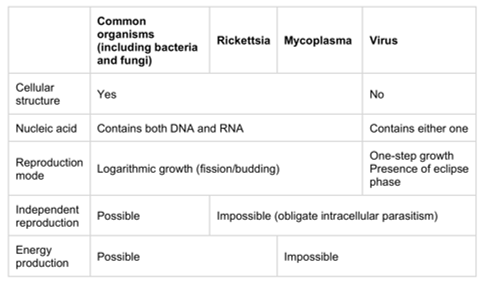
Table 1-1 Key Differences Among General Organisms Revised and cited in part from https://ja.wikipedia.org/wiki/ウイルス
Since microorganisms are microscopic in size, a microscope is required to observe them. Bacteria and fungi can be observed with an optical microscope (biological microscope), but viruses are even smaller, so an electron microscope is required for observation. When considering organisms including microorganisms using their size as an indicator, it is roughly as shown in Figure 1-1.
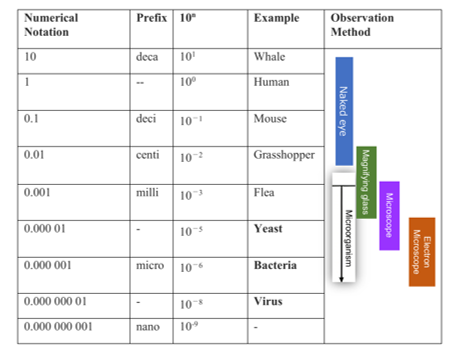
Figure 1-1 Sizes of Microorganisms
【As an aside】
Taking “1(one)” as the reference point, the units for larger magnitudes progress as “10”, “100”, “1,000”, “10,000”, and so on. Conversely, the units for smaller magnitudes are “1/10”, “1/1,000 “, “1/10,000”, “1/100,000”, and finally “1/1,000,000″. ” Micro” is a unit denoting 1/1,000,000″—precisely the “Micro” in ” term microorganism. Furthermore, 1/1,000,000 of a meter is 1 μm (micron), which is the typical size of common bacteria.
Author

Senior Consultant, GMP Platform, CM Plus Corporation
After working in sterilization management, microbiology, and quality assurance at Johnson & Johnson, Creative Medic, and Boston Scientific, he joined CM Plus, Inc. in 2013.
While working for the medical device manufacturer above, he participated in the Health and Welfare Science Research Group and various sterilization-related committees as a specialist in ethylene oxide sterilization.
About GMP Platform (https://www.gmp-platform.com/)

*If you are using Google Chrome, right-click and select “Google Translate” on the article.