


History of Microbiology 2-2
After Pasteur’s negation of the theory of spontaneous generation in the mid-19th century, many studies were conducted on the relationship between diseases and microorganisms, deepening the understanding of what we now call infectious diseases.
(Quoted from Wikipedia)
Reference
(Koch, Robert. Zur Unterusuchung von pathogenen Organismen. 1881. Mittheilungen aus dem Kaiserlichen Gesundheitsante, Vol.1. 1-48)
During this period, Japanese microbiologists also achieved many results. Shibasaburo Kitasato (pure culture of tetanus bacteria in 1889, development of serum therapy in 1890) and his student Kiyoshi Shiga (discovery of dysentery bacteria in 1897) are widely known as prominent microbiologists.
Later, at the end of the 19th century, Dmitri Iosifovich Ivanovsky of Russia discovered viruses, revealing the existence of pathogens smaller than bacteria.
Entering the 20th century, Alexander Fleming of the United Kingdom discovered penicillin in 1928, and Selman Abraham Waksman of the United States discovered streptomycin in 1946, marking the beginning of the antibiotic era. Subsequently, new antibiotics were discovered one after another, and thanks to the treatment of infectious diseases with antibiotics, great progress was made in human life expectancy.
Later, in 1979, Frederick Sanger of the United Kingdom devised a method for determining the base sequence of DNA, which led to the evolution of microbiology into the era of biotechnology.
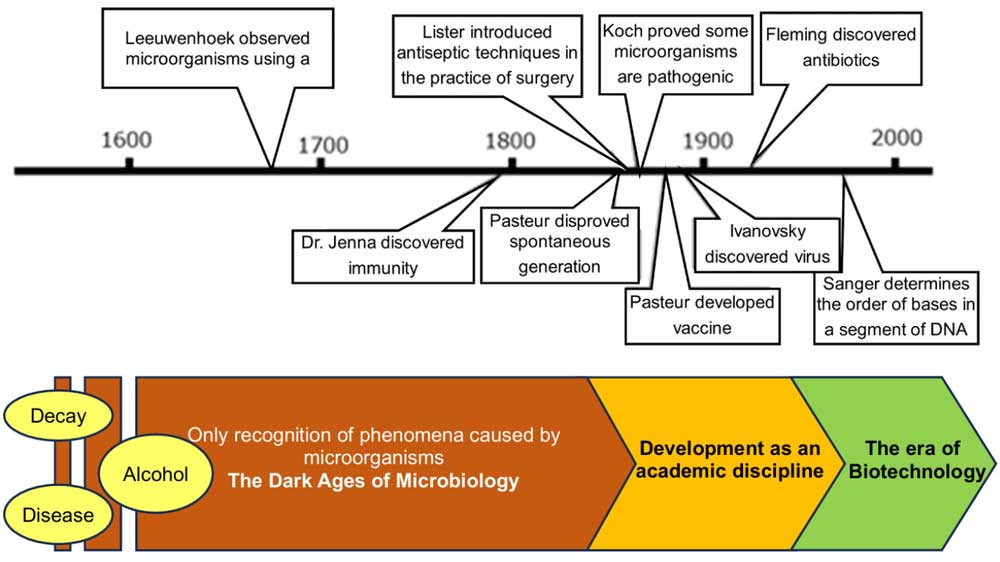
Figure 1 History of Microbiology
Life expectancy of Japanese people has increased sharply since 1950. Until the first half of the 20th century, the average human life expectancy was less than 50 years. This is because the infant mortality rate was high at that time, so 50 years old was not necessarily the natural lifespan. However, it is believed that the overall progress of medicine, especially the popularization of infectious disease treatment drugs such as antibiotics, has contributed greatly.
Author

Senior Consultant, GMP Platform, CM Plus Corporation
After working in sterilization management, microbiology, and quality assurance at Johnson & Johnson, Creative Medic, and Boston Scientific, he joined CM Plus, Inc. in 2013.
While working for the medical device manufacturer above, he participated in the Health and Welfare Science Research Group and various sterilization-related committees as a specialist in ethylene oxide sterilization.
About GMP Platform (https://www.gmp-platform.com/)

*If you are using Google Chrome, right-click and select “Google Translate” on the article.