


What Are Fungi?
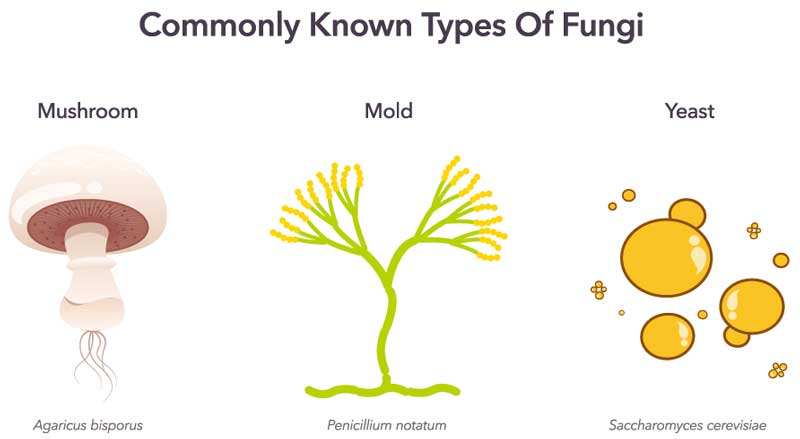
Fungi include familiar molds, yeasts, or mushrooms.
Generally, molds proliferate by spores (exospores), and yeasts proliferate by budding or division. The difference between the two can be simply understood as molds (filamentous fungi) being composed of many cells connected in a tubular shape, and yeasts being individual cells separate from each other.
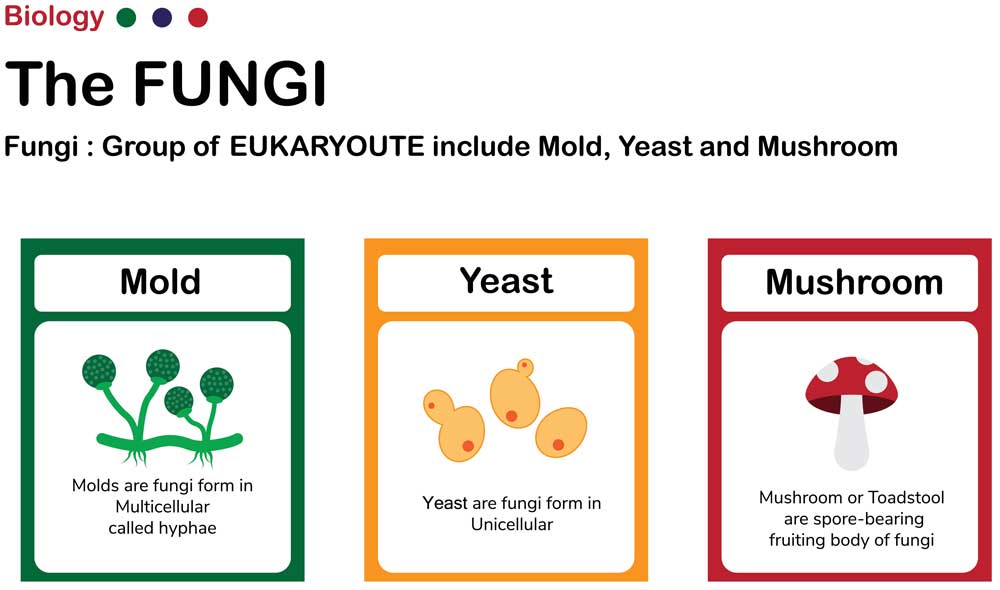
Fungal cells are eukaryotic and are considered higher organisms than bacteria. They generally grow under aerobic conditions (where there is air). However, yeasts can grow aerobically but also under anaerobic conditions and perform alcoholic fermentation under anaerobic conditions.
There are many fungi that we actively use. For example:
– Koji is a starter culture made by inoculating steamed rice or barley with Aspergillus oryzae (Japanese koji mold), used in the production of sake (Japanese rice wine), miso (fermented soybean paste), or soy sauce.- Yeast breaks down sugars to produce alcohol. All alcohol cannot be produced without the presence of yeast. Yeast is also indispensable for making bread.
– Mushrooms are well-known ingredients such as matsutake, shiitake, shimeji, and maitake. There are also poisonous mushrooms, but they are important as our food ingredients.
– Alexander Fleming of the United Kingdom accidentally noticed contamination by Penicillium during his experiment with Staphylococcus aureus (S. aureus) and found that the growth of Staphylococcus aureus was inhibited only around it, leading to the discovery of penicillin. Even today, penicillin is produced using Penicillium.
On the other hand, some fungi are pathogenic. They are generally called mycoses, for example:
– Athlete’s foot is an infectious disease caused by a mold called dermatophytes.
– Candidiasis is an infectious disease caused by a yeast called Candida albicans.
– A fungus (yeast) called Cryptococcus neoformans is abundant in pigeon droppings and causes pneumonia and meningitis.
Among fungi, especially filamentous fungi (molds) are widely distributed in nature, and their spores (exospores) are very easy to disperse and are often found in the air. Therefore, they may be brought into the manufacturing area attached to clothes. Fungal contamination brought in from the external environment in this way is one of the things to be careful about at manufacturing sites.
Author

Senior Consultant, GMP Platform, CM Plus Corporation
After working in sterilization management, microbiology, and quality assurance at Johnson & Johnson, Creative Medic, and Boston Scientific, he joined CM Plus, Inc. in 2013.
While working for the medical device manufacturer above, he participated in the Health and Welfare Science Research Group and various sterilization-related committees as a specialist in ethylene oxide sterilization.
About GMP Platform (https://www.gmp-platform.com/)

*If you are using Google Chrome, right-click and select “Google Translate” on the article.