



What Are Bacteria 2-2
Bacteria proliferate by division when the surrounding environment such as temperature, nutrients, oxygen, or osmotic pressure is suitable for the bacteria. This is where one bacterium becomes two, two become four, four become eight, eight become sixteen, and so on, doubling in number. The growth rate varies depending on the type of bacteria and surrounding environmental conditions, but for fast-growing bacteria such as Escherichia coli under optimal conditions, the time required for one division is said to be about 20 minutes. The time required for one division is called generation time. In this way, Escherichia coli can divide once every 20 minutes under optimal conditions, that is, three times per hour. If division continues at this rate, it will be as shown below.
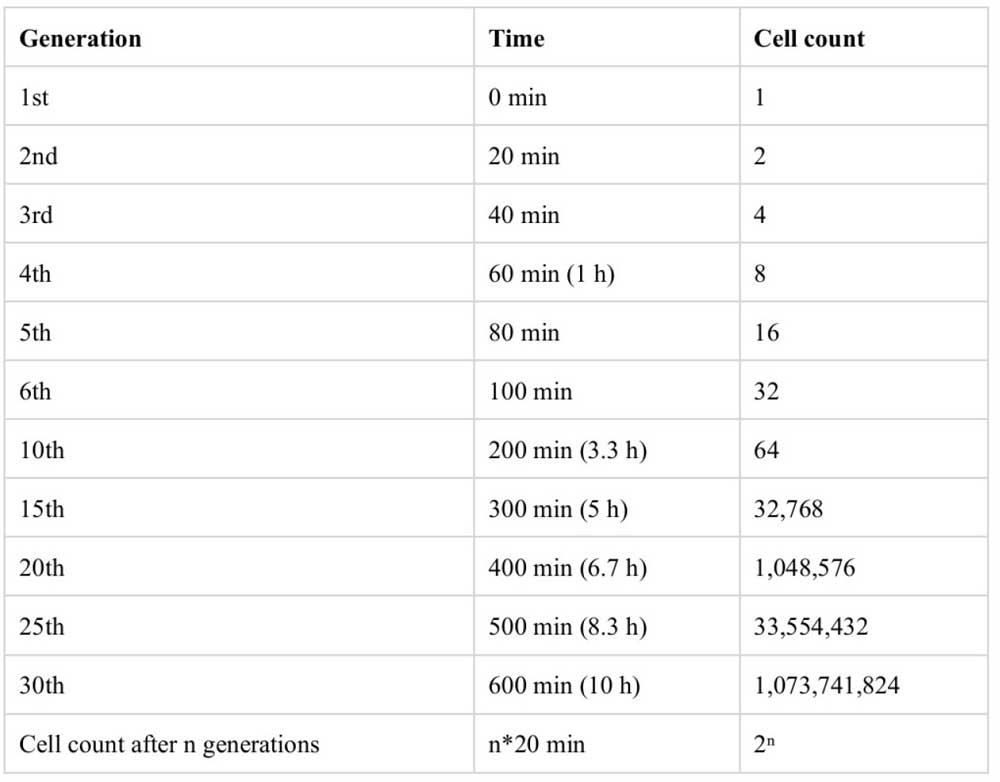
So if growth continues at this rate, how many viable bacteria will there be after one day? One day = 24 hours = 3 × 24 = 72 (generations). So putting 72 into n, the calculation is 2⁷² = 4.7 × 10²¹, an astronomical number.
When this bacterial growth is plotted on a graph, it is as shown in Figure 1. The left side uses a normal scale, while the right side uses a logarithmic scale for the vertical axis.
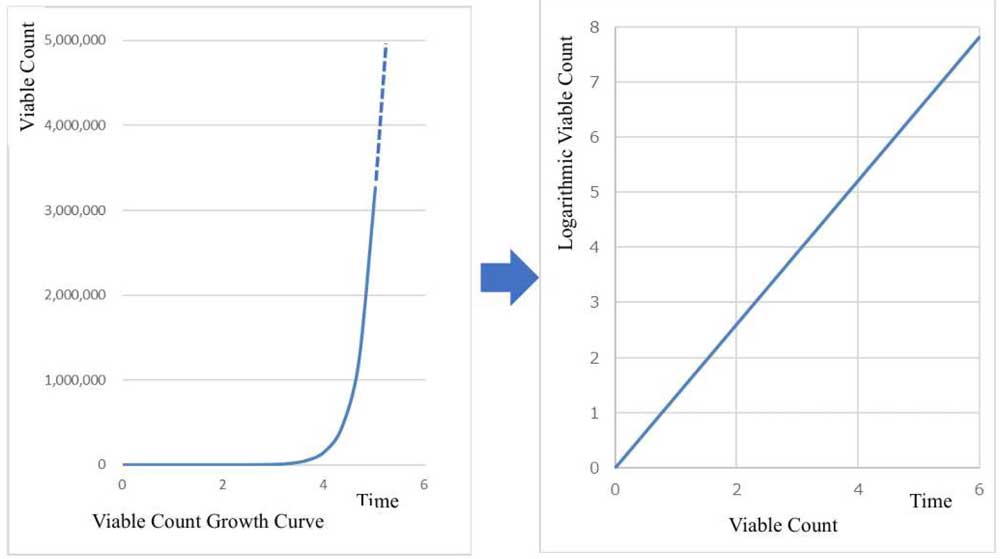 Figure 1 Microbial Growth
Since microorganisms (bacteria) proliferate by binary fission, if the surrounding environment and nutritional status are suitable for the microorganisms, they can reach an enormous number in a short time. However, in reality, when the number of viable bacteria in the medium reaches about 109 to 1010 /ml (1 billion to 10 billion per 1 ml), the growth rate slows down due to depletion of available nutrients, pH changes due to accumulation of metabolic products, etc., and eventually stops, leading to death. The extent of proliferation varies depending on the type of microorganism and the surrounding environment such as nutrients, but it does not continue to proliferate indefinitely.
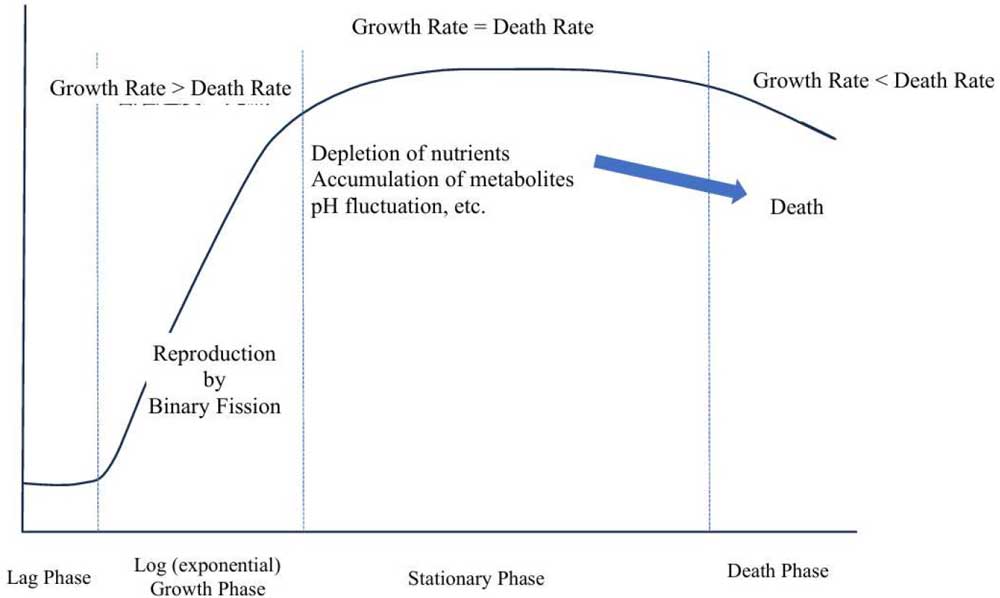 Figure 2 Example of a Microbial Growth Curve
Examples of things with a high number of bacteria in nature include dental plaque (plaque, a slimy and rough substance attached to the surface of teeth) or feces. Dental plaque contains about 600 types of bacteria, and it is said that there are about 100 to 200 million bacteria per 1 mg of plaque.
In microbiology, large numbers such as 1 million or 100 million, and conversely small numbers such as one-millionth, frequently appear. In such cases, it is easier to understand by considering “how many orders of magnitude” a number has rather than its absolute count. Therefore, in the microbial world, numbers are often expressed in the form of 10ˣ (10 to the power of X). For example:
・300 million = 300,000,000 = 3×10⁸ (3 multiplied by 10 to the 8th power)
・One-millionth = 1/1,000,000 = 1/106 = 10-6 (10 to the negative 6th power)
Furthermore, when using common logarithmic notation, log 108 = 8. For this reason, the vertical axis of graphs such as microbial death curves is sometimes presented in logarithmic (log) scale.
In addition, when describing the number of microorganisms, an exact count is meaningless. Therefore, it is common practice to express numbers with two significant figures, for example: 2,315,652 ≈ 2.3 million = 2.3 × 10⁶.
1 mg of plaque.
Author

Senior Consultant, GMP Platform, CM Plus Corporation
After working in sterilization management, microbiology, and quality assurance at Johnson & Johnson, Creative Medic, and Boston Scientific, he joined CM Plus, Inc. in 2013.
While working for the medical device manufacturer above, he participated in the Health and Welfare Science Research Group and various sterilization-related committees as a specialist in ethylene oxide sterilization.
About GMP Platform (https://www.gmp-platform.com/)

*If you are using Google Chrome, right-click and select “Google Translate” on the article.